Journal/Collecting fundamentals
Do Topps NOW and Panini Instant cards hold their value?
What print runs and sale evidence can tell collectors
The value of this exact card
There is no dependable category-wide answer. A Topps NOW or Panini Instant card may sell above its release price, but that alone does not establish a profitable investment. The edition, purchase cost, condition and time needed to find another buyer all matter.
The useful question is narrower: what evidence supports the value of this exact card? Print runs answer a supply question. Completed sales answer a price question. Neither, on its own, establishes what a collector will get back after costs.
This guide uses documented releases to explain that distinction. It does not estimate an average return or the proportion of on-demand cards that retain value over 12, 24 or 36 months.
The order window closes but demand can change
Topps describes NOW as a print-on-demand program with limited sales windows and a print run fixed after ordering closes. Windows vary; a blanket “24 hours” rule is too simple. Panini’s 3 June 2016 launch announcement described made-to-order cards, a 24-hour window and the total print quantity on the back. Those are historical launch terms, not a promise about every later Instant release.
This creates an important complication. For an on-demand base card, supply partly reflects how many copies buyers wanted at release. A small run may identify an overlooked moment, but it can also record limited interest. A large run may reflect broad enthusiasm while leaving plenty of copies available later.
The number of copies is not the number of owners. Bulk orders, dealer stock and collectors holding several copies all affect the relationship. Nor does a final run reveal how many owners would sell at a particular price.
The collector’s task is to judge whether later demand for that edition can absorb the copies offered for sale. The print run helps frame that question; it cannot answer it.
Three releases that show the difference
EXAMPLE 01
Ohtani and the scale of a famous moment
Topps records 653,737 copies sold for Shohei Ohtani’s 2024 MLB Topps NOW #722, the 50/50 release. Its 2024 retrospective separately identifies the Gold autograph 1/1.
Those are very different objects. The large run establishes the scale of the release, while the autograph has a separate supply. A sale of the signed 1/1 cannot value an unsigned base copy. Equally, the run alone cannot prove that the base has lost value. That needs comparable sales and a defined starting price.
EXAMPLE 02
Curry and the release package
The official 2024 Olympic Games Topps NOW #27 page lists Stephen Curry’s ordering window as 11–14 August 2024 and the print run as 89,838. It also describes numbered parallels, a silver-foil image variation and autograph redemptions. For this particular release, the advertised hits were additional to the base card.
That matters when comparing the original offer with a later base-only sale. The release purchase included a chance at extras. A buyer choosing an ordinary base copy on the secondary market is choosing a known item. Part of the original offer has changed. We cannot measure how much buyers valued that chance from the print run, so we should not pretend the two offers are economically identical.
EXAMPLE 03
Wembanyama and a headline price
In its 11 August 2023 Draft Night article, Panini described a 33-card NBA Instant base set produced according to sales, alongside Red /25, Versicolor /5 and Black 1/1 parallels. It reported that Victor Wembanyama’s 1/1 had sold through a Dutch auction for $10,000.
That is a manufacturer-reported initial sale of a unique parallel. It supplies no resale outcome for its buyer and no price for the ordinary base card. Calling it evidence that “Panini Instant holds value” would turn one transaction into a claim it cannot support.
Match the card before comparing the price
Write down the year, publisher, program, card number, language, parallel or image variation, and whether the copy is raw or graded. Match the photographs and reverse where available. Athlete names and seller titles are not enough.
A graded gem-mint copy belongs in a different comparison from an ungraded copy with uncertain corners or surface wear. A different photograph can identify a separate variation. Lots and sets need special handling: dividing a mixed lot’s price by its card count does not establish the value of every card inside it.
ICX’s editorial policy requires exact identity before price comparisons. Its Moment Score organizes collectible characteristics; it is not a forecast of future prices or returns.
Asking prices and completed sales answer different questions
An active listing shows what a seller wants. A completed sale is evidence of an agreed price at a particular time, subject to the quality of the record. An ended listing without a sale is neither.
For each comparable sale, record the date, currency, condition, quantity and treatment of shipping. Check whether an accepted offer’s actual price is visible. A displayed original asking price can survive after a lower offer is accepted.
Show the sample size, date range and spread. A median can reduce the influence of an unusually high or low observation, but it cannot repair mixed editions or duplicates. Multiple units associated with one listing should not be presented as independently checked transactions.
Liquidity needs its own question: how often does the exact edition sell, and how long might you wait? One old sale does not show that another buyer is available today. No captured sale is a gap in coverage, not proof of zero demand.
Holding value after costs
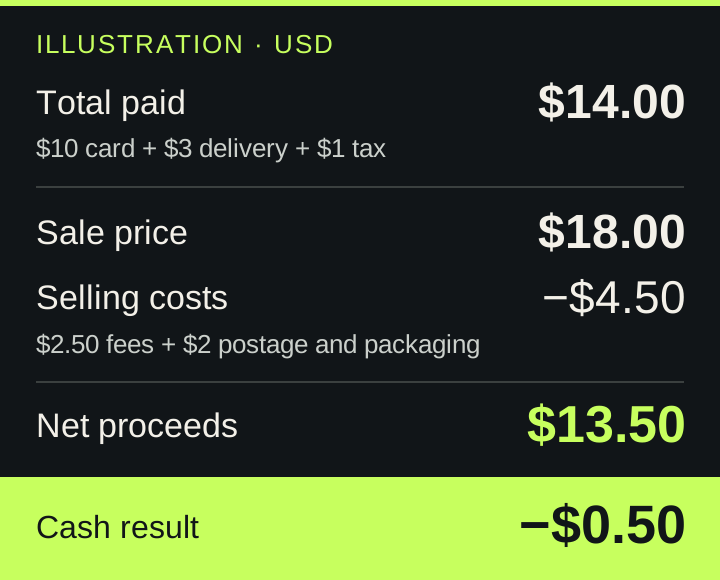
For a collector, recovering the original outlay means comparing net sale proceeds with the full acquisition cost. Include purchase shipping, taxes or import charges, and any grading expense. On exit, allow for marketplace fees, postage, packaging and other selling costs.
Consider an illustration, not an observed card transaction. A card costs $10 plus $3 delivery and $1 tax: $14 in total. It later sells for $18. Assume $2.50 in selling fees and $2 in postage and packaging, with no extra shipping payment from the buyer. The seller receives $13.50, a $0.50 loss. The item price rose 80%, yet the cash outcome was negative.
Actual fees vary. Currency changes and inflation can also matter over a long holding period. A comparison with a publisher’s single-card price describes a different result from the return earned by someone buying a discounted bundle or paying a premium later.
What the evidence supports
The three examples were selected to explain supply, release terms and edition matching. They are not a representative performance sample. Manufacturer records support their release facts; Panini’s $10,000 figure is attributed to its report. No independently verified secondary-market sale series is presented here.
A credible long-term study would define its cards before looking at outcomes, retain weak performers and cards with no observed sales, and compare the same formats over consistent periods. It would also separate gross price changes from net returns. A list of memorable winners cannot do that work.
For the next card you consider, establish its exact identity, find recent comparable completed sales and calculate what selling would leave you. If those facts are missing, value retention remains unproven. You can still want the card for the moment it preserves; just keep that reason separate from a claim about profit.
Sources and scope
Sources reviewed 4 October 2026.
- Topps NOW · program overview
Current program description: limited order windows and print-on-demand supply. Release terms vary.
- Panini Instant · 2016 launch
Historical launch announcement, 3 June 2016. Its 24-hour terms do not establish every later release’s terms.
- Topps Ripped · biggest pulls of 2024
Manufacturer retrospective: 653,737 copies sold for Ohtani #722; the Gold autograph 1/1 is a separate edition.
- Topps · Stephen Curry #27
Official #27 release: 11–14 August 2024, print run 89,838, with advertised hits additional to base cards.
- Panini · NBA Instant Draft Night
11 August 2023 report of the 33-card set and Wembanyama’s $10,000 initial Dutch-auction sale; no resale result.
- ICX · editorial policy
Exact-card identity, source standards and the limits of the ICX Moment Score.
Collectibles can be illiquid and volatile. This article is educational and does not provide financial, tax or legal advice.